
Thoughts on the Bubble...I mean the market sorry. (06/17/2026)
Never the same river twice

YOU KNOW WHERE YOU ARE?!?!

You’re in the bubble baby….
Only a few days ago I wrote a piece on Adobe after earnings where I candidly lambasted the “shoot first and ask questions later” attitude so many investors seem to have towards Adobe. Its more like, “keep shooting and don’t ask questions.” Now look, its a stock, it represents a pice of a business. Maybe its interesting, but its not that interesting. And yet so many people subscribed to this substack for what was ultimately…not my best work. It was ripe with “feeling” - something I should do my best to avoid on a Substack called “Margin of Sanity.”
I’m flattered, and glad to have you here, but frankly i’m a little concerned.
What has slowly dawned on me is that Adobe’s stock has become a topic in and of itself. There’s “Trump,” there’s “Abortion” there’s “Iran,” there’s “Drug Legalization” and many other “hot topics.” But Adobe is now…somehow…one of them.
This is the bit I didn’t really understand when I started buying the stock. No one told me about it at all, and I didn’t read other people’s research. I just use Adobe’s tools a lot and know many other who do too, and I took a look at the business itself and the price. Then I made a decision and acted on it. Simple as that.
I fish where the fish are - that is - where the other fishermen aren’t. Software is the place no one wants to be right now, so of course that is precisely where i’ll poke around. Anyway…
I try to limit my exposure to the finstack/fintwit/fintube world, but after that post generated so much attention I began to wonder if perhaps I wasn’t accidentally putting myself in the middle of…controversy?! No…that cant be the word for it.
DRAMA!
Thats the word I was looking for: drama.
This isn’t a piece about Adobe because I’m not sure I have a lot more to say on the matter, but instead I want to share some thoughts I have on this market (as I occasionally do). You may have just joined this world of “investors,” and think the whole thing is fun and easy. Recently, it really has been.
And thats bad.
So i’m going to do my best to make this a bit less fun. Investing is fun…but not in the way you’re thinking. Investing should be a bit like sitting on a rowboat on a lake with a fishing pole “fun,” but recently…its become a waterslide…
So speaking of water, lets begin with an aphorism i’ve always liked:
"No man ever steps in the same river twice, for it's not the same river and he's not the same man."
Heraclitus (c. 535–475 BCE)
Human beings are wired to see patterns, even when they don’t exist. Its why we see shapes in clouds or the Virgin Mary on a piece of toast. We look for logic when chaos is the driving force of life, and we look for the comfort of history when trying to see the future. The very nature of financial markets is that they are not ever predictable. Sure, some people will inevitably get it right for a period - the millionth monkey on the typewriter hammering out Shakespeare - but that same monkey rarely writes a hit sequel. So here we are, yet again in “unprecedented times.”
Tell me, when weren’t we in “unprecedented times?”
Steam engines
Combustion engines
Electricity
Human flight
Two world wars
The atom bomb
The Cold War
Double oil-shock and stagflation of the 70’s
The collapse of the Soviet Union
The Dot-com boom
The Dot-Com crash
9/11
Afgan/Iraq Wars
The Great Recession
The recovery from the great Recession (and the longest period of near-zero interest rates in history)
The Rise of China
Trump 1
Covid-19
Trump 2 (directors cut)
And now the “AI Revolution.”
…
During this last century and a half, our nation’s leaders changed every few years - as often did the leaders of our allies and enemies.
Never the same river twice.
The “big events” can sometimes shape our world in pretty meaningful ways, but the real miracles tend to happen slowly, incrementally, and over a long period of time. The increased life expectancies in developed countries, commercial flight, or even just the accessibility of automobiles did not happen overnight. Time takes time. But options contracts settle quickly.
Data Points
In science, there is something called a “sample size.”
Its not an elusive concept, but it does speak to the mentality of individuals trying to be precise. You can’t look at a couple of data points and draw conclusions. You need many many many data points to discover anything at all. One or two data points is almost meaningless to a scientific mind - and rightfully so. Moreover, experiments are conducted in sterile laboratory environments which seek to eliminate any and all particulates or variables. And finally, the scientists themselves are supposed to rigorously pursue accuracy.
I can’t think of anything less scientific than consuming a myriad of various “takes” on the internet from sources of questionable repute (and that includes the NY Times), but this is overwhelmingly the methodology adopted by the average retail investor today. The Finstack community - once a small and somewhat credible club of nerds - has become more or less a cesspool for bad-takes. Lots of passion, lots of pixels, but very little experience or transparency. This isn’t universal, but the incentives for even reputable writers to simply “keep talking” when there isn’t much to say is undeniable. Its ironic in a way that money is more or less the catalyst for the collapse of the Finstack world. We investors - more than most - understand that when there is demand, a free market economy will deliver the goods. So what does this market of “internet investors” demand?
Certainty? Drama? Excitement?
How about all three?
I’m sure plenty of folks seek something more substantive, but a quick look through Substack notes or youtube comments or even just some of the articles on here show me that the cathedral is seeding ground to the casino…fast.
I’m well aware that no “bet” of mine is truly a sure thing, but I think part of the reason that post on Adobe drove so much traffic was because I was “convicted” (or I sounded that way). Passion, big statements, and HUGE IDEAS are what captivate investors in 2026.
And look I realize that 1) I’m the guy that wrote that, and 2) at least 50 or so people reading this might be understandably irritated by some of what I might be implying.
What i’m trying to express is just that i’m sticking my hand in the river, and the current is a step-change quicker than it was 6 months or a year ago.
I’m off topic.
Where was I?
Oh right….
Thoughts on the Market
Characteristically, my prelude was both pompous and self-indulgent, but it also had a point: Investors are confidently drawing conclusions without possessing most of the relevant data points. The latter part of that statement is often true (investors never have all data), but its the confidence that I find interesting. No one can see the future, but there is an abundance of people out there willing to speculate about it.
Its not so much that I think investors have actually become more confident, but more that I think the market has become crowded with investors who seek the feeling of certainty. That is to say, investors want to trust. Worse still - investors want to gamble.
For years, the crypto market (specifically altcoins and meme coins) functioned as the internet’s premier casino. It was where retail traders went for high-risk, high-reward speculation. However, starting around the 2024 US election and accelerating into 2025 and 2026, that speculative energy found a new, more appropriate home:
Prediction markets
You can see this play out in the numbers. In recent 2026 earnings reports, major retail platforms like Robinhood reported massive drops in crypto revenue (nearly 40-47%), which analysts explicitly attribute to users shifting away from crypto trading and toward new forms of speculation on prediction markets.
While standard crypto trading volumes have stagnated or declined in growth, prediction markets are clearing tens of billions of dollars a month, trading on everything from Federal Reserve rate cuts to geopolitical conflicts and pop culture.
Gambling is not a productive economic activity, and should be heavily regulated (NOT TAXED). If we have learned anything at all in the last decade its that easy access to dopamine more or less functions like a genocide on young men. Im wayyy off topic now, but I felt like I should say it. Drugs (“prescription” or otherwise), porn, social media, gambling, and nicotine are all counterproductive as hell, but sadly I don’t expect this trend to shift anytime soon.
Where was I?
RIGHT! The market.
Now look, AI is not the only thing happening right now. Its just not. Its merely the only thing seemingly anyone can talk about.
Somewhere out there are rooms full of petroleum engineers trying to get the maximum amount of carbon atoms out of Canada’s oil sands as they possibly can. Some terrorist is plotting a new attack. Some car company is working on a natural gas powered vehicle. There’s probably a Sweed or an Israeli working on a new type of software that, for example, helps homebuilders use less materials in their builds. A million little things are happening, but dying media outlets and hungry Youtubers are just going where the clicks are. So fine. Thats fine.
Since everyone is talking about AI, lets talk about AI.
Almost 6 years ago now, I made a bet that turned into my best idea. It was very very simple. There was a company trading at something like 22 TTM earnings with pretty great economic characteristics, and this company was the leader in the manufacturing of semiconductor chips. It seemed at the time that their competitors (Samsung and Intel) were truly dropping the ball. I bet that mankind would need more compute power in the future, and that this company - Taiwan Semiconductor - would be the leader in that space.
Nailed it.
~550% later, I sold the stake after 1) Realizing I had made false assumptions when assessing the China risk and that it was higher (albeit still fairly low) than I previously thought, and 2) I was pretty sure AI had become a proper bubble, and TSMC would be among the victims of an inevitable crash.
I also used to own a lot of QQQ and have since sold the majority of it over the last 6-months.
Point being i’m not some “tech bear.” I believe in the power of technology to change things in ways most of us cannot even imagine. But this “everything or nothing” attitude society has adopted towards virtually every topic is - in my view - pretty weird. People take comfort in the idea that the largest and most powerful companies on Earth are investing directly in this AI buildout (all besides Apple). But i’d argue that they had no choice. That failure to invest in AI compute would have placed the beloved cloud businesses of Google, Microsoft, and Amazon at a serious competitive disadvantage. In fact, Sundar Pichai (CEO of Alphabet) said precisely this:
"When we go through a curve like this, the risk of under-investing is dramatically greater than the risk of over-investing for us..."
Besides, Google in particular was facing what the market assessed as an existential threat to their bread and butter search business. Regular people were already using Perplexity and Chat-GPT 3-years ago to find answers that Google should have been monetizing. It wasn’t since the days of Ask-Jeeves that a human went to find information on the internet and wasn’t using Google search to do so. And then OVERNIGHT that changed in a material and apparently permanent way. So we can understand that the risk assessment for a company like Google had less to do with getting a good return on capital, and more to do with keeping its competitive position intact.
Just like Buffett, large tech companies have the problem of “too much cash” and “not enough ideas to deploy it.” So when this new frenzy for AI took hold of every C-suite in America, it made perfect sense for the big tech players to go balls deep.
What i’m trying to say here is simply that intelligent people can make logical decisions and still lose money. You don’t have to think Sundar Pichai is dumb to also think that AI is a giant bubble.
But right now what I think about constantly is that the people who are actually paying the cost for all this AI are just the private equity firms who keep giving Open AI and Anthropic money. They subsidize the entire ecosystem (as does NVDIA) in the hopes that if people and businesses have enough time to experiment with AI, they’ll find ways to optimize their businesses that far exceed whatever cost they paid for the AI. As in, they create and supply a technology, and then subsidize it’s cost in the hopes that other people will find ways to actually create the wealth.
Lets just level set for a moment about this idea of “wealth.” What is it really? Well, I usually think about wealth as simply a better organization of available resources as oriented around the needs of human society. In short, its just a better way to do something humans wanted to do.
Traveling with a car is better than a horse so long as the car doesn’t cost 100x the wage of the average person, and gasoline is affordable. Remember, gasoline was a byproduct of the refining of crude oil into Kerosine. The order of events was cheap access to gasoline first and then then the propagation of the internal combustion engine. But the internal combustion engine was competing with a f$%#ing horse! Not a steam engine. It was another 100 years before another means of propulsion was considered a serious threat to the ICE: that is, electric cars.
And STILL!!! It is STILL not at all clear who the winner will be. Without the government leaning on the scales, major automakers have pulled back from EV’s in a big way. Why? Because when you build an entire economy around an already-awesome technology (which you consistently improve over many years), it is not so easy to displace it.
Software is an awesome business already. Our economy is very efficient. There is not a lot of “low hanging fruit” in the replacement of the existing organization. Semiconductors already went from small to nanoscopic. Actually, hang on…let me illustrate this:
Here is a picture of what a single transistor used to look like:

That is a single transistor. It can be turned “on” (1) or “off” (0), and that “on/off” represents the binary code that our society runs on. So that picture above is a single transistor.
Here is what a single 3nm semiconductor chip from TSMC looks like:

Guess how many transistors are on that chip….
Guess….
Well if you guessed one million, you would be off by about 99.999 billion
For context that is 1 million x 1,000 = 1 billion
TIMES 100!!!!!
We cannot do that again.
That remarkable journey from 1 → 100,000,000,000 is the primary force behind More’s law. And its over. Of course, the cost per-chip and the speed at which fab’s like TSMC can produce said chips are still improving. But that absurd and hard to comprehend shrinkage in transistor size is not a tailwind that drives everything in perpetuity.
Now, leading frontier models have gotten more efficient in the way they actually operate - primarily by segmenting the “brain” of the AI in such a way that the “coding brain” is the only part that is “thinking” when you ask it a question. The advent of “reasoning” and agentic workflows on top of that seemingly one time efficiency have resulted in the actual cost of “AI” going up.
And in none of the circumstances is anyone actually paying the COST of their AI. This is naturally becoming an issue for Anthropic and Open AI, and so they’ve experimented with actually charging customers something closer to what it would actually cost them….
This was met with 1) users switching to different models, 2) companies re-assessing their AI budgets, 3) users simply using less AI.
Here is a section from “AI Super-Bear” Ed Zitron:
Shortly after Uber COO Andrew Macdonald said that it was “getting harder to justify” spending money on AI as it was “very hard to draw a line” from that spend to useful consumer features (after its CTO said Uber burned its entire annual token budget in four months), Axios’ Madison Mills reported that one company had accidentally spent $500 million in the space of a month on Anthropic’s models after failing to set spend limits. A few days later, Mills would report that other companies were now looking for ways to reduce their AI spend.
That’s because, as I’ve said before, nobody can actually measure the ROI of AI, or even create a standard measurement of the cost of a task thanks to the inevitable hallucination-prone nature of LLMs and the ever-growing list of different harnesses and “agentic” (sigh) interfaces. Every different prompt and project and interaction can go wrong in a way that is hard to predict or plan for other than having an eternal vigilance that the supposed “intelligence” doesn’t do something catastrophically stupid, because LLMs have no thoughts, consciousness or ability to learn outside of pre and post-training.
If you can’t measure how good something is, how much it might cost, or what your return on investment might be, it’s fair to ask why you’re even paying for it in the first place.
People are (reasonably!) harping on about the ROI problem, but I think the “can’t really measure the cost” part is an even bigger problem.
Yesterday, Microsoft’s GitHub Copilot moved all customers to token-based billing from a premium request model (as I reported a week before everyone) as users had been allowed to burn thousands of dollars of tokens on a $39-a-month subscription.
Customers are irate. One burned through 50% of their monthly credits in a single prompt, another burned 60% in the space of a few hours, another 31% in a single prompt, another estimated that they’d burn their monthly credits in the space of a single five hour session, another burned nearly half of their credits in eight prompts, another around 14% of their credits in two prompts, and another lamented that GitHub Copilot had gone from their favorite subscription to their most-stressful overnight after burning 33% of their monthly balance in a few hours.
And, to be clear, this is during a promotional period where you get $11 or $21 in free monthly credits:
So look, i’ve gone on long enough I think. But a few lessons I’ve learned from studying past market frenzies are these:
There’s usually something tangible underneath the hype that helps bridge the gap between rational thinking and irrational thinking. Its never all tulips.
Politicians, regulators, and media outlets have no incentive whatsoever to throw water on the fire.
Other “credible” investors attend dinner parties with the very people profiting from these cycles, and therefore also have no incentive to open their mouths
Madness can go on longer than most of us expect
“Everyone” means “us,” not them.
50,000,000 Elvis Fans Can't Be Wrong
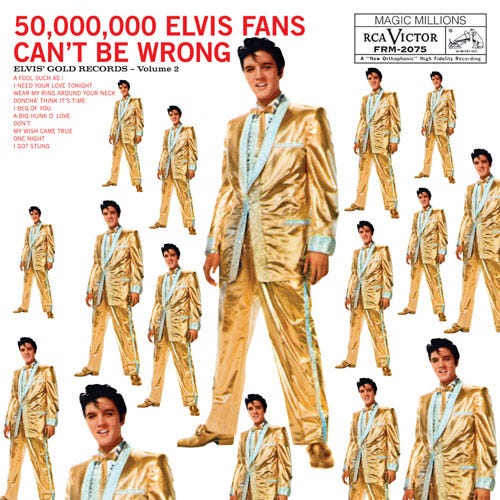
On that last point about “everyone.”
Maybe this is just me, but when I read about bubbles I don’t really see “myself” in the fray. I see myself as a wise separate entity - and so does everyone else.
Most investors today have a rational explanation as to why it is their position - their pick and shovel, which is the smart choice.
“Its not the hyperscalers, its the neo clouds that are overvalued”
“Its not the neoclouds its the startups.”
“Its not Antrhopic, its Open AI.”
“Its not the energy providers its the utilities”
“Its not Amazon its Oracle.” (that ones me, I own Amazon still)
It reminds me of the horse track gambler who “has a system…not like these other degenerates.”
But 50 million Elvis fans can’t be wrong! And yet that is exactly what happens every time. Its not like you could have asked a mortgage broker in 2006 if the housing market was in a giant bubble and gotten the answer “yes.” Or a software engineer in 1999. Or a steel worker in the American Railroad bubble. THIS ISN’T HOW SOCIETY WORKS. The whole POINT of a bubble is that we throw caution to the wind and are emboldened by the belief of those around us. Your buddy who uses AI for coding stuff isn’t proof of very much.
This is what Charlie Munger would call “Social Proof” and its coupled along side “Authority Misinfluence Tendency” (rich/powerful people are authority figures), and supercharged by envy/jealousy (fomo). This is barely scratching the surface, but my point is that more than half of the +20 tendencies towards human misjudgment that Munger lays out in his lecture are present today. And it is US! Yes, us here on substack (along with millions of others) who make up “everyone.” We all want to believe our information sources are the good ones (excessive self regard tendency), and that good things will happen (over-optimisim tendency). The whole reason books are written on these topics is because we find it so fascinating that we can know all of this information, and yet proceed into the same traps over and over.
One of my favorite books is Charles McKay’s “Extraordinary Popular Delusions and the Madness of Crowds.” What I find so fascinating, is that this book was written in the 19th century, long before the roaring 20’s or the dot com bubble. Three generations before my very birth this guy recognized that humanity has this ability to be naive and foolish as a collective.
The point is merely that we are the 50 million Elvis fans.
You know where you are?
Talk to ya later.
MoS
Disclaimer: Not investment advice. This publication is for education and entertainment only. Nothing here is an offer, solicitation, or recommendation to buy or sell any security. I may own (or short) securities mentioned and may change positions at any time without notice. Investing involves risk, including loss of principal. Do your own research and consider speaking with a licensed adviser who knows your situation.